
The way teams work is changing fast. Over the past year, I’ve been experimenting with AI tools, talking to founders and engineers, and watching how teams actually adapt when they get their hands on these new capabilities. What I’m seeing is a shift away from the old model where everyone had clearly defined lanes toward something more dynamic — where AI handles execution while humans focus on strategy and creative problem-solving.
This isn’t just about adopting new tools. It’s about rethinking how we solve problems, build products, and work together.
The Great Shift: From Rigid Roles to Fluid Collaboration
The old way was straightforward: Product Managers wrote requirements, Designers created specs, Engineers built the solution. Everyone had their lane, information flowed in sequence, and handoffs were the norm.
But we’re witnessing a fundamental shift. AI has become a universal translator that lets anyone participate in previously specialized domains. When a CEO can prototype an idea in 20 minutes using natural language, when a designer can generate working code, when an engineer can conduct user research — the traditional handoff model starts feeling unnecessarily slow.
This transformation is possible because AI has solved the learning constraints that once kept us locked in our roles. In the past, crossing functional boundaries was genuinely difficult. Learning design principles as an engineer, understanding technical architecture as a PM, or grasping business strategy as a designer required months or years of traditional study.
Now? We can use tools like NotebookLM to synthesize complex content, AI assistants to help us understand difficult papers that were previously inaccessible, and consume knowledge through podcasts during fragmented time. The barriers between disciplines are dissolving.
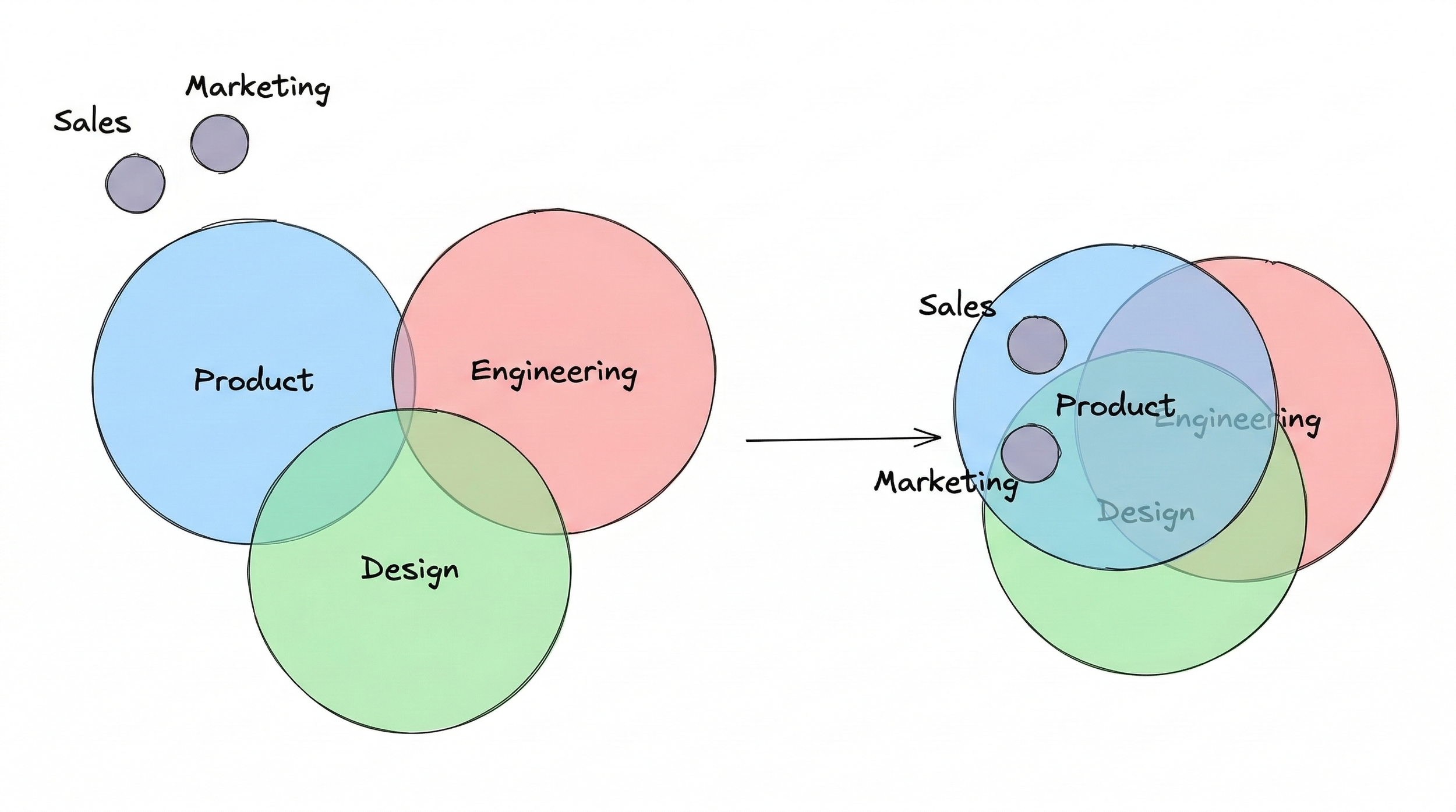
Traditional role boundaries (left) vs. AI-enabled fluid collaboration (right). Source: Aman Khan
As Howie Liu, Co-founder and CEO of Airtable, puts it: “Success in the AI era favors polymathism and the breakdown of traditional role silos. There is a strong advantage to any of those three roles [PM, engineering, design] who can kind of cross over into the other two.”
The integration of roles isn’t just possible now — it’s becoming inevitable. The future isn’t about working separately in defined lanes; it’s about working together to solve problems in parallel, with each person contributing across multiple domains.
Five Things I’ve Learned Building AI-Enhanced Workflows
Through my work developing what I call “Vibe Working” (moving beyond just coding to reimagining entire workflows), I’ve noticed five patterns that are reshaping how effective teams operate:
1. Start Small, Iterate Based on Real Friction
I used to think like a traditional PM — trying to build comprehensive solutions upfront. Now I focus on the smallest, most immediate problem and solve it quickly.
Here’s how this played out with our theme adjustment workflow:
| Iteration | Problem Identified | AI-Powered Solution | Impact |
|---|---|---|---|
| V1 | Designers can't visualize code parameters | HTML preview generator | Eliminated design-code misalignment |
| V2 | 16 separate previews too cumbersome | Single HTML showcase multi examples with tab switching | Streamlined review process |
| V3 | No real-time adjustment during meetings | Added live color picker + reset function | Enabled collaborative experimentation |
| V4 | Manual screenshot workflow inefficient | Auto-download Python files + thumbnails | Instant meeting-to-implementation pipeline |
| V5 | Font combinations needed testing | Dynamic font selection with previews | 5-minute team decisions vs. hours of mockups |
Each iteration was triggered by a real problem we encountered in practice. What used to take hours of mockups now happens in 5-minute decisions.
The insight: Your workflow becomes your MVP. Instead of treating work processes as fixed, treat them as products that can be rapidly improved based on actual friction points.
2. Fill the Grey Area — Stop Waiting for Answers
The old way was strictly linear: PM writes requirements → Designer reviews and creates specs → Engineer builds the solution. Each step waited for the previous one to be “complete.”
This creates artificial bottlenecks. When you encounter a problem that technically belongs to someone else’s domain, the traditional approach was to delegate and wait. But if we keep following this sequential method in the AI era, you’ll find it’s painfully slow.
Here’s the shift: everyone’s capabilities are expanding, so we can actually do many things in parallel. The grey area work in projects — those undefined spaces between roles — now requires all team functions to move forward together.
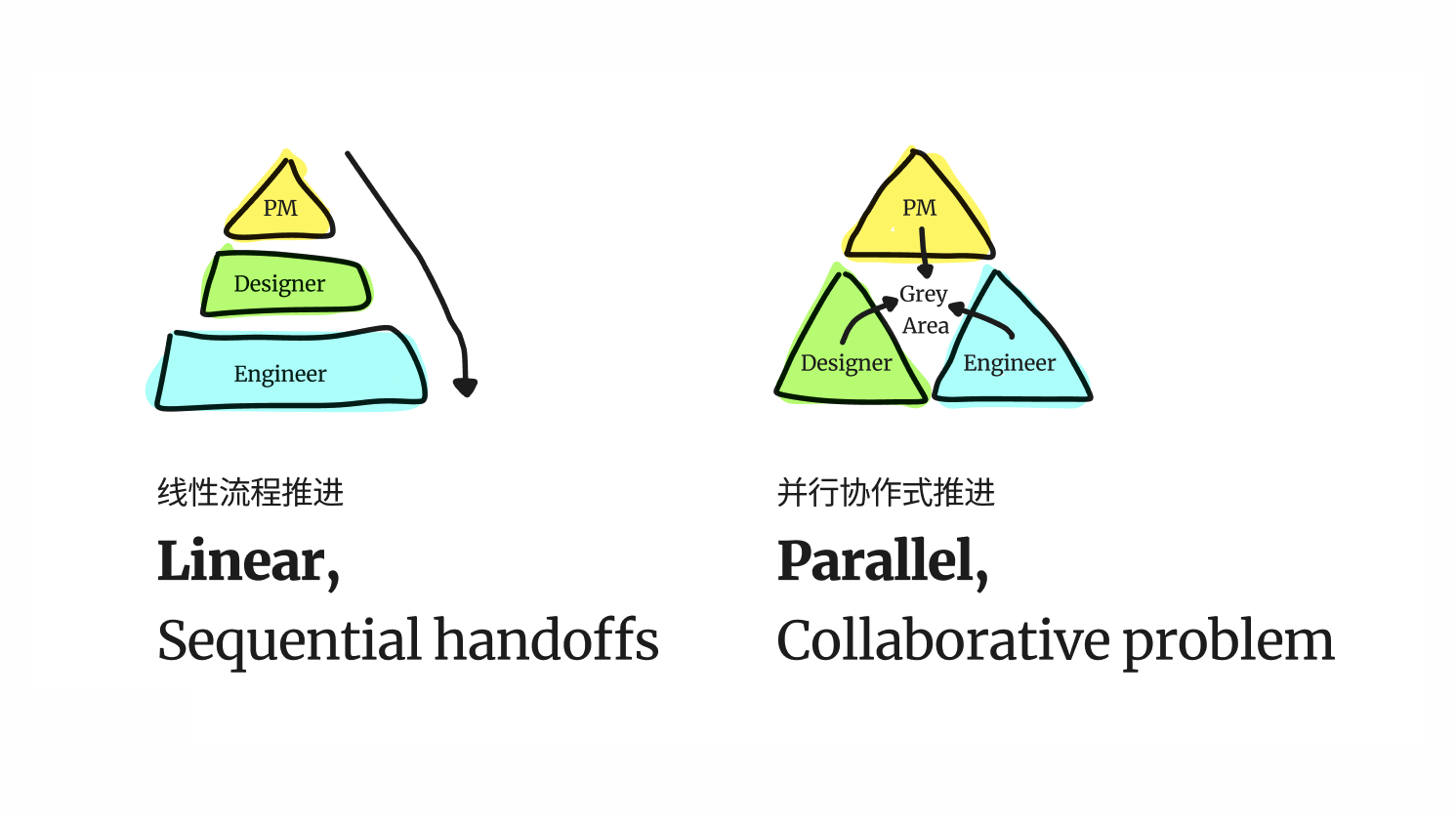
Instead of linear handoffs, we now have parallel, collaborative problem-solving where everyone helps fill the undefined spaces between traditional roles.
Julie Zhuo, former VP of Design at Facebook, captures this well: “When you have a PM & Designer, if you’re an engineer facing a product definition problem, the default feeling would be ‘that’s their job description, so I’ll delegate.’ But that’s a missed opportunity. Someone should make the call, but that doesn’t mean you shouldn’t be part of the organizer or initiator.”
The key insight: true collaboration isn’t about replacing someone’s role — it’s about working together to speed up and simplify the whole process.
3. Ship the Ugly-but-Functional Before the Beautiful-but-Useless
This saved us months on our last major project. Instead of perfecting the interface first, we built the core functionality with minimal UI and got it into users’ hands immediately.
The result? Rapid iteration, real user feedback, and organic evolution based on actual usage patterns rather than assumptions.
Focus on core value delivery first, then enhance based on real usage patterns. Beauty can always be added; functionality must be proven first.
4. Leaders Need to Get Their Hands Dirty
Dan Shipper, co-founder and CEO of Every, found something surprising in his research: “The single greatest predictor of successful AI adoption is whether the CEO actively and regularly uses tools like ChatGPT. An engaged CEO can drive excitement and set realistic expectations.”
This matches what I’m seeing across the industry. Howie Liu from Airtable codes more than ever: “You have to know what’s possible by being in the weeds in order to figure out what your product should be.”
Sebastian Siemiatkowski, CEO of Klarna, creates prototypes in 20 minutes that previously took weeks. Sundar Pichai, CEO of Google, uses AI-assisted programming for custom web pages — and AI now generates over 30% of new code at Google.
The benefits are real:
No need for separate reporting layers
Faster decisions based on direct understanding
Better team morale (“fighting alongside us” vs. “directing from above”)
More realistic AI strategies from leaders who actually use the tools
5. Think 5 Years Ahead — Invest in Non-Replaceable Skills
I learned this lesson when our custom theme color generation model — crucial for the project I was working on — was suddenly obsoleted by GPT-4’s improved capabilities. What took us months to build could now be achieved through simple prompting.
This crystallized three questions every team should ask:
What skills will remain uniquely human in 5 years?
Which current bottlenecks will AI solve automatically?
Where should we invest limited resources for maximum future impact?
The answer increasingly points to creativity, judgment, curiosity, and strategic thinking — the “WHAT” and “WHY” rather than the “HOW.”
Everyone Becomes a Director
Looking ahead, we’re seeing the emergence of new professional characteristics and collaboration models that fundamentally change how teams operate.
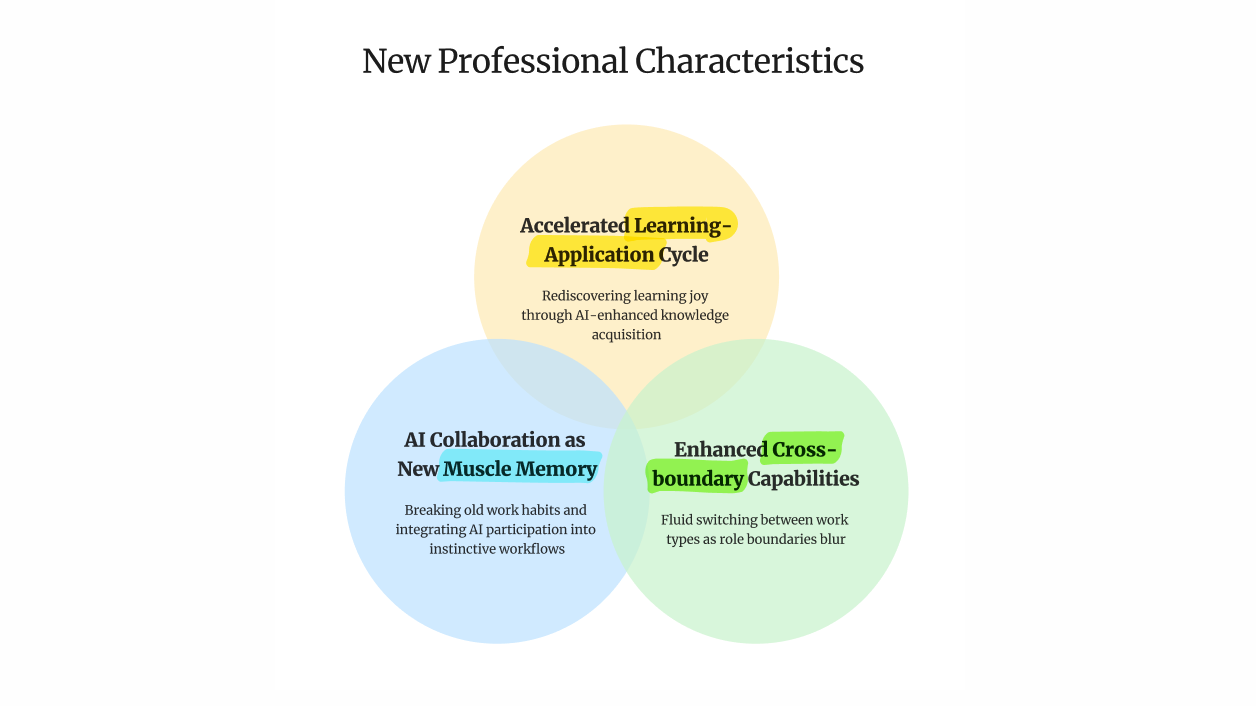
On the individual level, professionals are developing:
Accelerated Learning-Application Cycles — People are rediscovering the joy of learning through AI-enhanced knowledge acquisition. Instead of spending months mastering a new domain, you can now rapidly absorb and apply new concepts.
AI Collaboration as New Muscle Memory — Teams are breaking old work habits and integrating AI participation into their instinctive workflows. This isn’t about occasionally using AI tools; it’s about making AI collaboration as natural as checking email.
Enhanced Cross-boundary Capabilities — The lines between different work types are blurring. Fluid switching between roles becomes the norm rather than the exception.
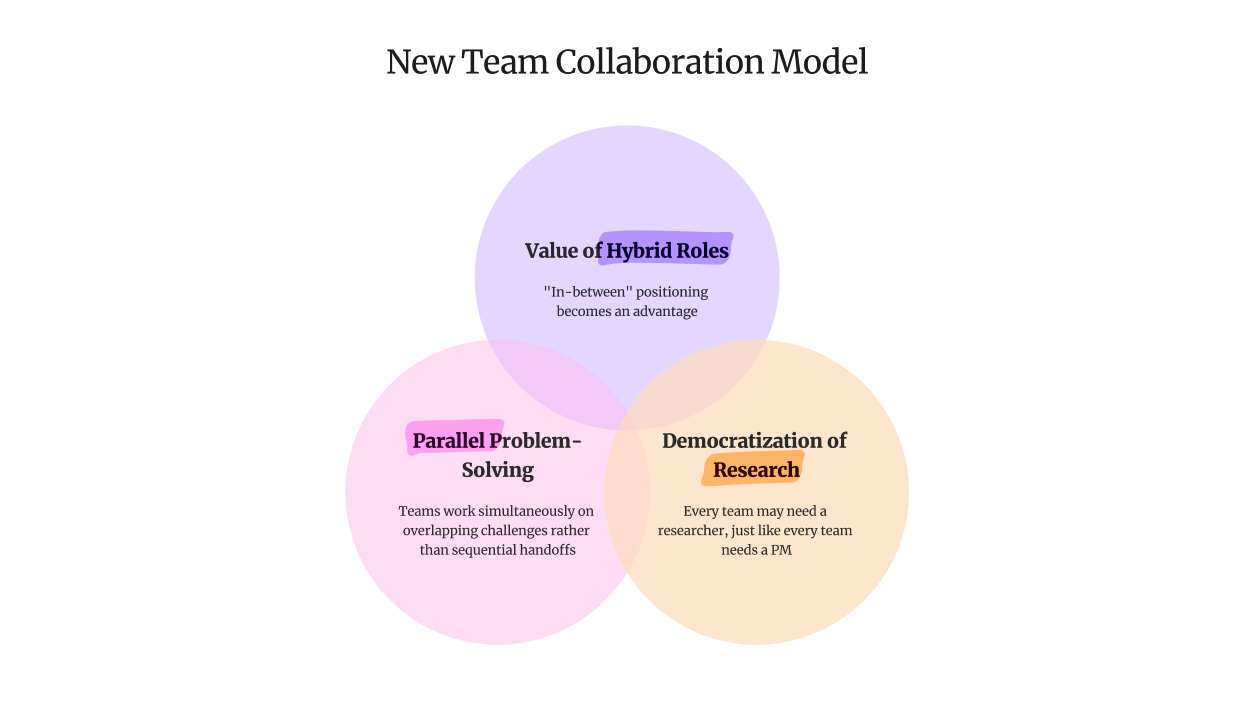
At the team level, we’re seeing new collaboration patterns:
Value of Hybrid Roles — “In-between” positioning becomes a competitive advantage. The people who can bridge domains become the most valuable team members.
Parallel Problem-Solving — Teams work simultaneously on overlapping challenges rather than sequential handoffs. This represents a fundamental shift from the linear approach that dominated for decades.
Democratization of Research — Every team needs a researcher, just like every team needs a PM. The ability to synthesize information and generate insights becomes a core competency across all roles.
The fundamental shift we’re experiencing: Everyone becomes a “director” with AI as the “execution team.” When AI handles the “HOW,” human value concentrates on the “WHAT” and “WHY” — Creativity, Curiosity, and Judgment become our core competitive advantages.
How Learning Is Changing Too
The AI era is also transforming how we develop skills:
Personalized intelligent tutors that adapt content in real-time
Multimodal interactive learning through speech, text, and visual interfaces
AI collaborative enhancement that amplifies rather than replaces human creativity
Real-time feedback systems with instant analysis and personalized guidance
Cross-disciplinary knowledge integration that breaks down subject silos
The pattern is acceleration without isolation — AI helps us learn faster while maintaining the human connections that remain irreplaceable.
Working in Parallel
What I find most exciting about this transformation is that it’s not about replacing human capabilities — it’s about removing the friction that prevents us from doing our best creative and strategic work.
True collaboration isn’t about replacing someone’s role; it’s about working together to speed up and simplify the whole process. When AI handles routine execution, humans can focus on the higher-order thinking that drives real innovation.
The new competitive advantage isn’t what you know, but how quickly you can learn, adapt, and orchestrate both human and AI capabilities to solve complex problems.
We’re not just adopting new tools — we’re reimagining what collaborative work can become. The teams that embrace this shift, that learn to work in parallel rather than sequence, that fill the grey areas rather than wait for perfect handoffs, will define the next era of innovation.
The future belongs to the people who can bridge domains, the problem-solvers who step into undefined spaces, and the directors who can orchestrate both human creativity and AI execution to tackle challenges we couldn’t handle before.